
Ocean Wave Hearing · Corpus Christi, TX
CROS and BiCROS Hearing Aids for Single-Sided Hearing Loss
CROS and BiCROS hearing aids help people with hearing loss in one ear by sending sound from the weaker side to the ear that hears better. CROS suits one ear with little or no usable hearing; BiCROS is for when the better ear also has some hearing loss. Your hearing test shows which fits.

By Ruben C. Cavazos, Jr., MS, HIS · Hearing instrument specialist, Ocean Wave Hearing, Corpus Christi
Quick answer: CROS and BiCROS hearing aids help people with hearing loss in one ear by sending sound from the weaker side to the ear that hears better. CROS suits one ear with little or no usable hearing; BiCROS is for when the better ear also has some hearing loss. Your hearing test shows which fits.
Many people experience hearing loss in only one ear while the other ear works normally or has some degree of hearing ability. This condition can make everyday conversations challenging, especially in noisy environments, meetings, restaurants, or when someone speaks from the side with weaker hearing.
For individuals with this type of hearing difficulty, CROS and BiCROS hearing aids can provide an effective hearing solution by transferring sound from the weaker ear to the ear that hears better.
At Ocean Wave Hearing, we help individuals understand their hearing options and find solutions based on their unique hearing needs. If you are exploring different hearing solutions, you can also learn more about our hearing aid options and how modern technology can support better communication.
Schedule your hearing consultation today and discover whether CROS or BiCROS hearing technology is right for you.
What Are CROS and BiCROS Hearing Aids?
CROS and BiCROS hearing aids are specialized hearing devices designed for people with single-sided hearing loss or uneven hearing loss between both ears.
Unlike traditional hearing aids that amplify sound directly into the weaker ear, these systems use advanced wireless technology to capture sound from the poorer-hearing side and send it to the better-hearing ear. Interacoustics
These devices are especially helpful for people who:
- Have little or no usable hearing in one ear
- Struggle hearing conversations from one side
- Find noisy environments difficult
- Need better awareness of sounds around them
How Do CROS Hearing Aids Work?
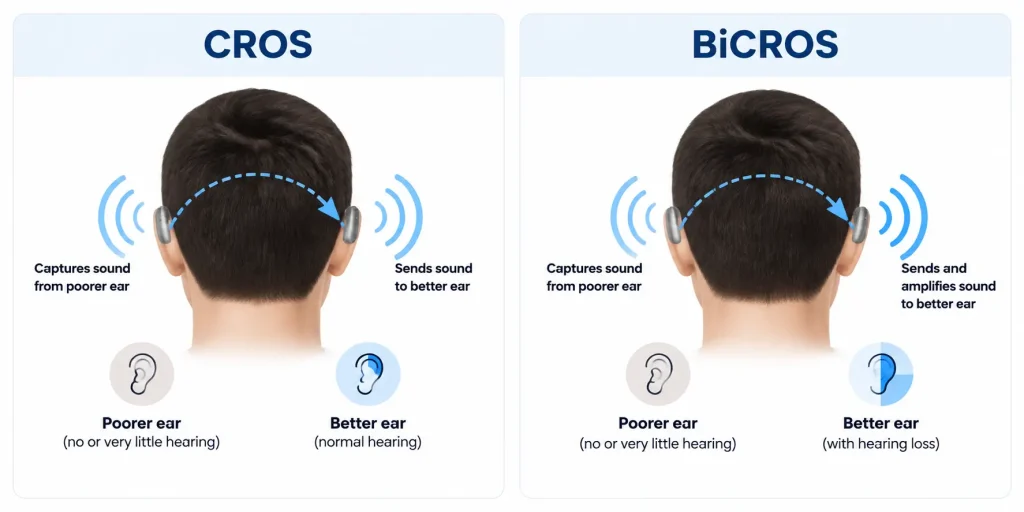
CROS hearing aids (Contralateral Routing of Signal) are designed for people who have severe hearing loss or no usable hearing in one ear, while their other ear has normal or near-normal hearing. Starkey
A CROS system typically includes:
- A small microphone device worn on the poorer-hearing ear
- A receiver device worn on the better-hearing ear
- Wireless technology that transfers sound between both devices
The microphone picks up sounds from the side where hearing is limited and sends those sounds to the better ear. A clinical review in the NIH’s PubMed Central library describes CROS the same way, and notes that BiCROS is typically used when the better ear also has mild to moderate hearing loss.
For example:
Imagine you have hearing loss in your left ear. Someone sitting on your left side speaks to you, but you cannot hear them clearly. A CROS hearing aid captures their voice from your left side and sends it to your right ear.
This helps reduce the problem of missing sounds coming from the weaker side.
What Are BiCROS Hearing Aids?
BiCROS hearing aids are designed for people who have severe hearing loss in one ear and some hearing loss in the better ear.
Unlike CROS systems, BiCROS devices provide amplification for the better ear while also transferring sound from the poorer ear.
A BiCROS system:
- Picks up sounds from the poorer ear
- Sends those sounds wirelessly to the better ear
- Amplifies sound for the better ear when needed
This makes BiCROS hearing aids useful for people with asymmetric hearing loss where both ears need support. HearingLife
CROS vs BiCROS Hearing Aids: What Is the Difference?
Understanding the difference between CROS vs BiCROS hearing aids helps determine which solution may fit your hearing condition.
| Feature | CROS Hearing Aids | BiCROS Hearing Aids |
|---|---|---|
| Hearing Condition | One ear has little/no hearing, other ear hears normally | One ear has little/no hearing, other ear also has hearing loss |
| Amplification | No amplification needed in better ear | Better ear receives amplification |
| Main Purpose | Transfers sound from poor side to good side | Transfers sound and improves hearing in better ear |
| Best For | Single-sided deafness | Unequal hearing loss in both ears |
A hearing evaluation from a qualified hearing professional is important before choosing between these two options.
Benefits of CROS and BiCROS Hearing Aids
Choosing the right hearing technology can improve confidence and communication.
1. Hear Sounds From Your Poorer Side
One of the biggest advantages of CROS and BiCROS hearing aids is improved awareness of sounds coming from the side where hearing is limited.
This can make conversations easier without constantly turning your head.
2. Better Communication in Conversations
People with single-sided hearing loss often struggle when:
- Someone sits on their weaker side
- Multiple people are talking
- Background noise is present
These hearing solutions help make speech easier to access.
3. Wireless Hearing Technology
Modern wireless CROS hearing aids use advanced connectivity to transfer sound between devices quickly and comfortably.
Many newer hearing aids also include:
- Rechargeable batteries
- Smartphone connectivity
- Noise reduction features
- Bluetooth streaming
Who Can Benefit From CROS and BiCROS Hearing Aids?
You may be a candidate for CROS and BiCROS hearing aids if you experience:
- Hearing loss in only one ear
- Single-sided deafness
- Difficulty understanding speech from one direction
- Trouble following conversations in restaurants or meetings
- Unequal hearing ability between both ears
However, the best option depends on your hearing test results, lifestyle, and communication needs.
How to Choose the Right CROS or BiCROS Hearing Aid?
Before selecting a device, consider:
Get a Professional Hearing Test
A hearing evaluation determines:
- The level of hearing loss in each ear
- Speech understanding ability
- Whether CROS or BiCROS technology is suitable
Consider Your Daily Lifestyle
Your hearing needs may differ depending on whether you:
- Work in meetings
- Spend time in social environments
- Frequently use phones
- Attend public events
Choose Proper Hearing Aid Fitting
Proper fitting and programming are essential for getting the best performance from your hearing device.
Which Option Fits Hearing Loss in One Ear?
Living with hearing loss in one ear can affect conversations, confidence, and daily communication. CROS and BiCROS hearing aids provide modern solutions by helping users access sounds from their weaker side and improve overall hearing awareness.
The right choice depends on your hearing test results, lifestyle, and personal goals.
If you are experiencing single-sided hearing loss, contact Ocean Wave Hearing today for professional guidance and explore whether CROS or BiCROS hearing technology can improve your hearing experience.
Frequently Asked Questions
CROS hearing aids transfer sound from the poorer ear to the better ear, while BiCROS hearing aids also amplify sound in the better ear.
Yes, CROS hearing aids are commonly used for people with single-sided deafness where one ear has little or no usable hearing.
Yes. BiCROS hearing aids support people where one ear has severe hearing loss and the other ear also needs amplification.
Adjustment time varies. Some users adapt quickly, while others may need several weeks to become comfortable.
Coverage depends on your insurance plan and location. A hearing provider can help explain available options.
Sources
- Nonsurgical Management of Single-Sided Deafness: Contralateral Routing of Signal, Journal of Neurological Surgery Part B (2019), via PubMed Central, NIH National Library of Medicine
- Hearing Aids, National Institute on Deafness and Other Communication Disorders (NIDCD), NIH